.png)
Oct 2025
This article was originally published in Decoding, our monthly briefing on the latest trends in government technology. Sign up here to receive future editions directly in your inbox.
.png)
This year's Beyond GovTech in Copenhagen reaffirmed a simple truth: digital resilience cannot be built in isolation. Organised by Digital Hub Denmark, under the Danish EU Presidency, the summit brought together ministers, senior officials, and digital leaders from across Europe, Africa, and Asia to explore how governments can balance sovereignty, innovation, and collaboration.
Across the globe, digital resilience has become the shared language of governance – connecting policy, technology, and international cooperation in a rapidly changing world.
In Brussels, digital policy has entered a new phase. Regulation is necessary, but no longer enough: digital resilience has now become Europe’s guiding principle. From platform accountability to sovereign cloud and secure AI, the EU is building the political, technical and industrial capabilities to remain competitive in a more hostile digital environment.
This month’s Decoding examines the two fronts of Europe’s strategy: defending public trust and rebuilding technological independence. Both themes converged at Beyond GovTech 2025, where global leaders explored how states can secure sovereignty while scaling innovation.
In this edition:

This year, Beyond GovTech centred on digital resilience and how governments can secure digital sovereignty while fostering innovation and collaboration. The high-level summit took place in Copenhagen on 28-30 October, bringing together ministers and senior government officials from across Europe, Africa, and Asia.
Key themes included:
In her opening remarks, Minister for Digital Affairs Caroline Stage highlighted collaboration as a Danish superpower – a theme reflected throughout the three-day summit, where policymakers, innovators, and digital leaders explored how trusted digital governance can strengthen democracy, transparency, sovereignty, and innovation.
The programme was designed to keep collaboration between governance and innovation at the centre of discussion, while also connecting the discourse to digital sovereignty, security and interoperability.
The first day gathered government officials at Digital Hub Denmark for high-level roundtable discussions on digital governance and policy. Participants shared actionable steps on how to strengthen digital government:
Responsible AI in the public sector
Digital sovereignty and resilience
Digital identity for inclusion and trust
These discussions set the stage for the summit’s main day, where the theme of digital resilience took on a global dimension.

The main day brought together more than 200 representatives from government, international organisations, and the tech industry at Langelinie Pavillonen in Copenhagen for a full day of panels, keynotes, and case studies.
Francesca Bria, project lead for EuroStack, connected digital sovereignty with supply chain vulnerabilities in a post-globalisation world marked by geopolitical turmoil, and raised the question of whether we are experiencing an AI boom or an AI bubble. Her keynote underscored a defining message: if we don’t control our digital infrastructure, we can’t control our future.
Discussions throughout the day addressed strategic autonomy through digital sovereignty and resilience, with concepts like digital imperialism and transactional anarchy entering the debate. Many highlighted that digital sovereignty must not be mistaken for protectionism, and that interoperability and public procurement remain key to Europe’s competitiveness.
Case studies from leading Danish GovTech solutions illustrated how local solutions contribute to trust and collaboration on a global scale.
.jpg)
On the final day, participants selected one of three thematic tracks, with panels focusing on Global cooperation for digital government, Cities and regions in the digital age, and Digital resilience in an age of geopolitical shifts.
Panels explored international collaboration platforms for government technologies, with a focus on knowledge sharing and trade facilitation. Discussions called for a common platform that enables access to GovTech solutions – one that prioritises interoperability and collaboration over national branding.
Beyond GovTech 2025 reaffirmed that digital resilience is not built in isolation. It demands political will, technical capability, and cross-sector collaboration founded on trust. The summit brought together leaders from government, international organisations, and the tech industry in an open and forward-looking forum for dialogue at the intersection of policy, technology, and international cooperation.
What truly defined the event was the participants' openness and commitment to collaboration – turning discussions into shared understanding and ideas into collective action
The insights shared and questions raised at Beyond GovTech reflected a broader movement: translating the principles of digital resilience into concrete policy and governance measures.
Are you interested in participating in next year's edition of Beyond GovTech? You can apply for a seat here.
.jpg)
Europe’s focus on digital sovereignty and resilience has been intensifying under the Danish EU Presidency. October was the official European Cybersecurity Month, offering practical guidance for EU citizens to stay safe online.
In her State of the Union speech, European Commission president Ursula von der Leyen called for a strategic push to strengthen the EU’s independence and resilience across defence, energy, industry, and digital domains. She also highlighted the need for stronger measures to address the impact of social media on children, pointing to concerns over algorithmic targeting and addictive platform design. She announced the establishment of an expert panel to provide recommendations on improving the online safety of minors.
On 9–10 October, this political signal was matched by coordinated action. Under the Danish EU Presidency, the EU’s digitalisation ministers met in Horsens, Denmark, to address digital risks faced by minors. The meeting resulted in the adoption of The Jutland Declaration: Shaping a Safe Online World for Minors, which outlines:
According to Danish Minister for Digital Affairs, Caroline Stage, the declaration establishes a shared political direction for future EU regulatory work on online safety. The discussions also strengthened alignment on Europe’s broader digital sovereignty agenda, ensuring that regulatory, technical, and governance measures support a resilient digital ecosystem.
In parallel, the European Commission issued formal Requests for Information under the DSA to Snapchat, YouTube, Apple’s App Store, and Google Play. These aim to clarify how platforms implement age assurance, limit minors’ exposure to illegal or harmful content, and mitigate digital risks.
Ensuring a safe online environment for minors is more than a child protection agenda – it is a stress test for Europe’s digital resilience. Exposing structural vulnerabilities, strengthening oversight, and reinforcing trust in digital infrastructure are all critical to a resilient and competitive European digital ecosystem.
Child safety online intersects with another primary debate shaping Europe’s digital future: how far should governments go to secure online safety without compromising encryption, privacy, and cybersecurity? The ongoing negotiations around the EU’s Child Sexual Abuse Regulation (CSAR) proposal illustrate this complex balance.
More than 40 European tech companies, including Proton, Tuta, Element, and NordVPN, issued an open letter to EU Member States urging lawmakers to ensure that any regulation preserves strong encryption. The letter emphasised that encryption is not only essential for individual privacy but also crucial for Europe’s cybersecurity, economic competitiveness, and digital sovereignty.
Signatories cautioned that the current CSAR approach could undermine these objectives by requiring client-side scanning or introducing backdoors, thereby weakening security and creating systemic vulnerabilities. Such measures could erode public trust in European services, disproportionately affect SMEs that rely on privacy-first offerings, and unintentionally strengthen the position of foreign technology providers. The letter concluded with a clear call for proportionate, effective child protection measures that safeguard minors while maintaining the integrity of European digital infrastructure.
As of the time of writing, the latest development in the CSAR debate is the withdrawal of a proposal that would have made chat monitoring mandatory for all messaging platforms, as the proposal did not receive sufficient support. An amended proposal has been submitted and is pending approval by EU member states.
The CSAR debate illustrates a central challenge for Europe’s digital strategy: how to safeguard citizens online without compromising the very encryption and trust that underpin a resilient and sovereign digital ecosystem.
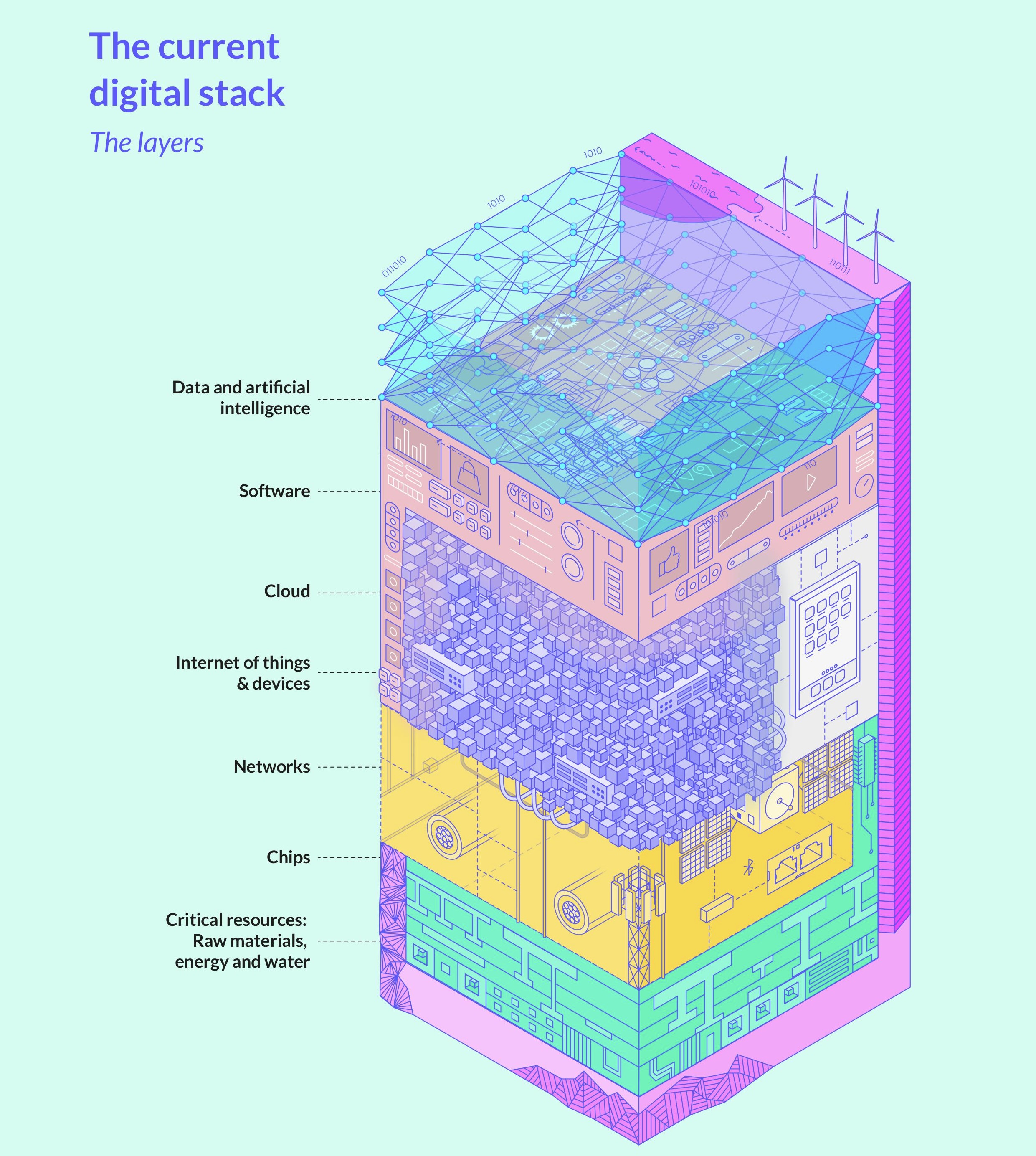
While regulation and trust form the governance backbone of digital resilience, true sovereignty also depends on the ability to build the technical capabilities that make Europe less dependent on foreign providers. This is the ambition behind EuroStack – Europe’s emerging sovereignty stack.
In a previous issue of Decoding, we explored The European Way – a call to arms urging Europe to move from digital dependency to digital resilience. The message was clear: Europe cannot regulate its way to sovereignty. It must build it. That means investing across the full technology stack – infrastructure, compute, identity, data, and foundational governance.
Around the world, countries are building Digital Public Infrastructure (DPI) to organise how states manage identity, payments, and data exchange. India’s modular DPI “India Stack” has become the poster child of digital development, enabling citizen services at an unprecedented scale and now being exported across the Global South, supported by the UNDP and philanthropic institutions.
But Europe’s challenge is different. While countries like India and Brazil have built citizen-facing infrastructure without local cloud or compute capacity, Europe has both the resources and the political mandate to create a comprehensive digital value chain, spanning from hardware and cloud infrastructure to application layers and governance frameworks.
EuroStack answers that challenge. It aims to secure Europe’s entire technology stack, encompassing hardware and cloud infrastructure, applications, secure payments, data spaces, and governance. It is not just another regulatory initiative; it is a strategic industrial project – a sovereignty stack to underpin Europe’s economy, defence, and democratic freedoms in a world defined by digital power.
→ Read more about EuroStack

During Beyond GovTech 2025, Digital Hub Denmark launched a white paper titled "Resilience by Design: Securing Europe’s Digital Foundations." With voices from the industry on how to secure data and maintain trust, as well as testaments from Brussels on the challenges of EU adoption versus innovation, the white paper ties together resilience, cybersecurity, quantum, and sovereignty.
→ Read more and download the full white paper here.

🇪🇺 EU: Commission launches consortium to support sovereign European digital infrastructure and technology
The European Commission has established the Digital Commons European Digital Infrastructure Consortium (DC‑EDIC) to help Member States jointly develop and operate cross-border digital infrastructures. Founding members include France, Germany, the Netherlands, and Italy, with others able to join. DC‑EDIC will support interoperable, open, and sovereign digital infrastructures, provide governance and technical support, and promote reusable, GDPR-compliant digital tools.
🇺🇸 US: Senators call for ICE to halt use of Mobile Fortify app
Four US senators have demanded that Immigration and Customs Enforcement (ICE) suspend use of the Mobile Fortify app amid concerns over privacy, accuracy, and legal oversight. The app reportedly enables agents to perform facial recognition and contactless fingerprint scans using smartphones, which are linked to federal biometric databases. The demand to halt ICE’s Mobile Fortify app highlights a growing concern over how biometric surveillance is expanding from border control to everyday policing, raising urgent questions about transparency, civil liberties, and the limits of government monitoring in public spaces.
🇬🇧 UK: Digital ID scheme faces scrutiny over security
The UK government’s planned digital ID, mandatory only for employment checks, relies on Gov.UK One Login and the forthcoming Gov.UK Wallet to store personal data. Critics have raised concerns about past security lapses, delays in meeting cyber standards, and potential vulnerabilities to hackers. The government asserts the system follows the highest security protocols and undergoes regular testing, but questions remain about whether it can fully protect citizens’ data as rollout continues.
🇸🇪 Sweden: PM urges EU to simplify drone procurement standards
Sweden’s Prime Minister Ulf Kristersson called on the EU to streamline procurement rules for anti-drone systems, while maintaining national responsibility for building and deploying these capabilities. Kristersson stressed that the EU “is not a defence organisation,” but could play a role in streamlining standards and boosting cross-border collaboration. He also noted that Sweden, home to defence company Saab, which specialises in anti-drone technology, prefers procurement decisions to align with NATO targets rather than being centralised under the EU.
🇩🇪 Germany: €18 billion high-tech agenda launched
Germany has unveiled an €18 billion plan to lead in six key technologies: AI, quantum technologies, microelectronics, biotechnology, nuclear fusion, climate-neutral power and transport. Chancellor Friedrich Merz highlighted the agenda as crucial for national and European technological sovereignty, aiming to reduce dependence on the US and China. The plan includes research roadmaps, milestone-based funding, start-up support, and state-backed procurement.
🇩🇰 Denmark: Municipality tests AI supercomputer Gefion for public sector innovation
Vejle Municipality is piloting AI projects on Denmark’s most powerful AI supercomputer, Gefion, in partnership with TDC Erhverv and the Danish Centre for AI. The initiative allows the municipality to experiment with voice-to-text, text-to-voice, open-source LLMs, and image generation models, aiming to accelerate AI adoption across the public sector while maintaining data security and control. Lessons from the pilot are expected to guide other Danish municipalities in leveraging high-performance computing for digital transformation.
For questions, comments, or suggestions regarding this article, please get in touch with Emilia.
Enjoyed this edition of Decoding? Subscribe here to receive future insights on digital public services directly in your inbox.

.png)