.png)
Dec 2025
This article was originally published in Decoding, our monthly briefing on the latest trends in government technology. Sign up here to receive future editions directly in your inbox.
.png)
The question of digital sovereignty is closely intertwined with that of Digital Public Infrastructure (DPI). While the definition of DPI differs globally, the 2023 G20 Summit in New Delhi offered a shared reference point, defining it as “a set of shared digital systems that should be secure and interoperable, and can be built on open standards and specifications to deliver equitable access to public and/or private services at societal scale.”
Within the EU, support is growing for a sovereign digital infrastructure, known as the “Euro Stack”. Inspired by “India Stack”, it places stronger emphasis on sovereign solutions for hard infrastructure – an aspect that has been largely absent from earlier DPI discussions.
Across the world, Brazil, India, the EU, and other regions are developing different approaches to DPI to reflect local priorities, values, and interests. Yet in today’s complex geopolitical environment, there is also growing interest in interoperability and finding a common ground.
This edition of Decoding, the fifth in our series “Decoding Europe’s DPI”, explores opportunities for increased collaboration between the EU and countries in the Global South. Through initiatives like the EU Global Gateway Strategy, European policymakers are combining technology diplomacy with investment to strengthen sovereign digital infrastructure while promoting international collaboration.
In this edition, you’ll read about:
Launched in 2021, the Global Gateway Strategy seeks to narrow global investment gaps by mobilising public and private capital for hard and soft infrastructure in partner countries. Operating through a Team Europe approach, it enables coordinated action across digital, energy, transport, health, and education.
India has been promoting DPI globally as a path to digital sovereignty, but India Stack primarily focuses on the middle layer of digital infrastructure, emphasising scalability and interoperability. This leaves a gap in the tech stack, where challenges such as reducing dependencies and securing critical infrastructure are not fully addressed. Here lies an opportunity for the EU to collaborate with countries such as India, Brazil, and other like-minded partners to develop a comprehensive approach that combines open digital infrastructure with interoperable rules rooted in democratic values. Actively promoting a vision for a digital future that reflects European values would complement existing efforts, such as the widespread adoption of GDPR.
We have previously argued that Europe can’t regulate its way to digital sovereignty, it must build it. While this argument still holds, the EU does have a regulatory strength – the so-called “Brussels Effect” – that has the potential to shape the governance of DPIs. From GDPR to the EU AI Act and the Digital Services Act, EU regulations help set the framework for a responsible development of emerging technologies by shaping global norms.
The Global Gateway Strategy offers a concrete entry point: digital infrastructure projects backed by the EU may complement national or regional DPI initiatives, and the EU’s broader external investment agenda means that digital sovereignty, data governance, and interoperable systems become part of the same foreign economic toolset.
Global Gateway is a lever for shaping how the EU engages with the digital and infrastructure transitions in the Global South, and offers actionable pathways for public-sector leaders and innovators to plug into.
A key milestone of the Global Gateway Strategy is the Global Gateway Investment Hub, a new platform designed to streamline and amplify private sector participation in EU-backed infrastructure and digital projects worldwide. Launched at the 2025 Global Gateway Forum, the Hub provides a coordinated entry point for EU companies seeking to invest in partner countries across Sub-Saharan Africa, Asia-Pacific, and Latin America and the Caribbean. It brings together financial and technical support from the European Commission, the European Investment Bank, development finance institutions, export credit agencies, and national governments, enabling private investors to align their proposals with EU and partner-country priorities.
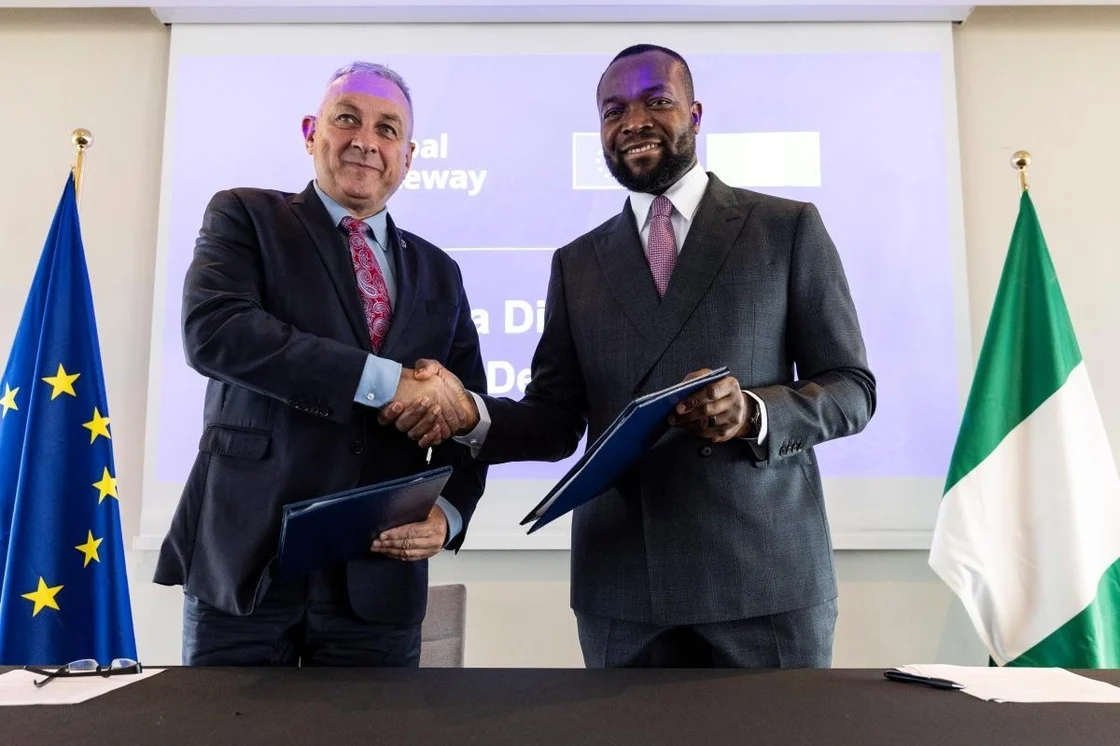
On 9 December, at the EU-Nigeria Digital Open Day in Brussels, Nigerian Minister of Communications, Innovation and Digital Economy, Dr. Bosun Tijani, and the European Commissioner for International Partnerships Jozef Síkela, signed a € 45 million programme completing the EU Digital Economy Package for Nigeria.
The programme includes support for the Project Bridge, which aims to deploy 90,000 km of fibre-optic network across Nigeria. The grant will support preparations in three ways: detailed fibre-optic network design, local skills development, and supply chain deployment, mobilising the EU private sector.
The objective of the EU-Nigeria Open Digital Day was to facilitate access to information for European investors and suppliers interested in participating in the Nigerian digital ecosystem. The Project Bridge was presented as an opportunity for collaborations between the EU tech sector and Nigeria.
While initiatives like Project Bridge lay the groundwork for expanding digital connectivity in Nigeria, the success of such programs depends on addressing the foundational layer of DPI, particularly access to reliable energy and sustainable infrastructure.
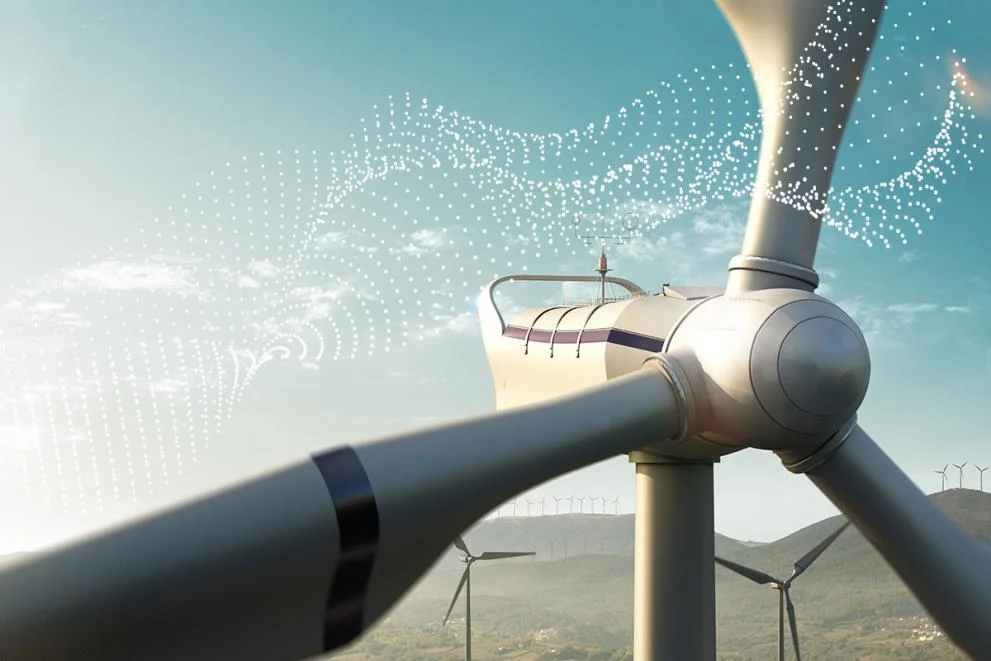
The DPI Stack is commonly understood to comprise three layers: the hard/physical layer, the soft/logical layer, and OTT/Intermediation layer. Ensuring a sustainable and resilient backbone, including access to critical materials like rare earth elements, highly skilled workers and diversified energy sources, is a prerequisite for a resilient DPI development. With a poor power supply, the foundational layer of the stack is missing, and the other layers will be more complex to put in place, or when put in place they will not be accessible to all, leading to a widening digital divide.
Nigeria exemplifies this challenge. Persistent power supply issues significantly increase the cost of operating rural base stations, reducing the commercial viability of expanding coverage into underserved communities, thereby locking millions of Nigerians out of the digital economy. In the context of DPI, this inability to consistently access the internet hinders progress in areas such as e-learning, mobile money adoption, and digital inclusion, all of which are crucial to national development. Nigeria’s ambitious fibre-optic rollout under Project Bridge illustrates both the potential and the challenges of building resilient digital public infrastructure.
With abundant solar resources, Nigeria has a clear technical pathway to reduce energy-related constraints. However, current investment levels in solar-powered telecom infrastructure remain insufficient relative to national demand. Scaling these solutions will require coordinated public–private action, policy incentives, and long-term financing instruments.
There is a strategic opening here for deeper EU–Nigeria cooperation. By aligning Nigeria’s renewable energy and connectivity goals with the EU’s Global Gateway priorities, particularly its focus on sustainable energy and secure digital infrastructure, both partners can strengthen the physical foundations of Nigeria’s emerging DPI while advancing a shared model of inclusive, interoperable digital development. For European companies and public-sector partners, the Global Gateway Investment Hub provides a clear entry point into this evolving landscape.
On 10 December, the EU Council endorsed the Global Gateway list of flagship projects for 2026. The list includes four flagship initiatives in Nigeria focused on expanding access to clean energy through solar and hydropower solutions – an essential foundation for sustaining digital connectivity and the broader DPI ecosystem.

🇪🇺 EU fines X €120M over Digital Services Act breaches: The European Commission has fined X €120 million for violating transparency obligations under the Digital Services Act. Infringements include the misleading design of X’s ‘blue checkmark’, a non-transparent advertising repository, and barriers to researchers' access to public data. The Commission said these practices expose users to scams, hinder scrutiny of ads, and obstruct research on systemic online risks. X has 60–90 working days to submit corrective measures, with potential further penalties if it fails to comply. This is the first non-compliance decision under the DSA.
🇪🇺 EU and World Bank deepen Global Gateway partnership
The European Commission and World Bank Group have strengthened their collaboration under the EU’s Global Gateway strategy, targeting 18 high-impact projects in energy, transport, and digital infrastructure across Africa, Asia-Pacific, and Latin America. The partnership aims to turn investments into local jobs, services, and economic growth, leveraging private capital and regulatory support while advancing sustainable, high-quality infrastructure. Leaders emphasised the focus on fostering local private sectors, youth employment, and regional integration, aligning strategic investments with long-term development and Global Gateway’s goals.
🇪🇺 EU-CELAC: Turning commitments into action
Two years after launching the €45 billion EU-Latin America and Caribbean Global Gateway Investment Agenda, EU and CELAC leaders met in Santa Marta, Colombia, to review progress and advance shared priorities. Initiatives highlighted include €6.86 billion for regional electricity integration, the Stormwatch climate resilience partnership, the EU-LAC Supercomputing Network for AI, expanded satellite connectivity, and green value chains for sargassum seaweed. The Summit underscored the partnership’s focus on sustainable infrastructure, digital and energy integration, citizen security, and public-private investment, translating commitments into tangible economic, social, and environmental impact across the region.
🇰🇪 Kenya: Region’s first GPU-powered AI infrastructure
Kenya has unveiled East and Central Africa’s first GPU-powered AI infrastructure, strengthening its role as a continental leader in sovereign AI capacity. The new AI facility will allow enterprises, startups, researchers, and public institutions to train and deploy AI models locally, without exporting sensitive data or relying on offshore cloud systems. Government leaders framed the launch as a major step toward an African AI Stack for sovereign development, reducing dependency on foreign compute and ensuring that the benefits of AI are built and governed within the region.
🇳🇬🇩🇰 Nigeria and Denmark sign MoU on AI, broadband, and innovation
Nigeria and Denmark have signed a Memorandum of Understanding (MoU) to strengthen cooperation on digital infrastructure, AI, and innovation. The deal, announced at the Nordic Nigeria Connect event in Lagos, includes €12 million in EU funding to train 3 million Nigerian tech talents under the 3MTT program. The MoU aims to scale broadband, pilot smart governance solutions, and foster pathways for Nigerian talent to contribute to Danish companies, highlighting Nigeria’s push to narrow its digital gap compared with Denmark’s leading e-governance and cybersecurity standards.
🇰🇪🇩🇰 Kenya and Denmark sign MoU to advance digital governance
Kenya and Denmark have signed a memorandum of understanding to advance digital governance, public service modernisation, and capacity building. The partnership, formalised in Nairobi on 6 November, will focus on digital infrastructure, interoperability, and knowledge exchange, supporting Kenya’s 2022–2032 Digital Master Plan. Denmark will share expertise on e-governance while Kenya seeks to expand citizen-centred digital services, enhance institutional capacity, and strengthen its role as a regional digital hub.
Beyond large-scale investment projects, European innovators are contributing practical solutions that advance DPI globally. One example is Partisia’s initiative, which addresses secure digital identity and data sharing in the healthcare sector. The initiative is an example of the second layer of DPI, focusing on data interoperability, access management, and citizen-centric services.
There is a growing need for a simple, privacy-preserving solution to verify patient identities throughout the healthcare journey. By leveraging Decentralised Identifiers and a secure digital wallet on the patient’s phone, individuals can seamlessly and securely prove their identity - whether visiting hospitals or general practitioners - without compromising their privacy.
.webp)
Together with EMI, Partisia facilitates the secure sharing of patient data across hospitals, general practitioners, and other healthcare providers - while ensuring that control remains firmly in the hands of the patient. Building on the digital wallet and decentralised identity framework, patients can hold verifiable and tamper-proof health information directly on their devices.
For scenarios that require continuous or periodic data sharing, patients can provide electronic consent through a digital signature, creating a transparent and auditable trail for both the sender and the recipient.
To ensure interoperability across systems and institutions, all shared data will be standardised according to the Fast Healthcare Interoperability Resources format.
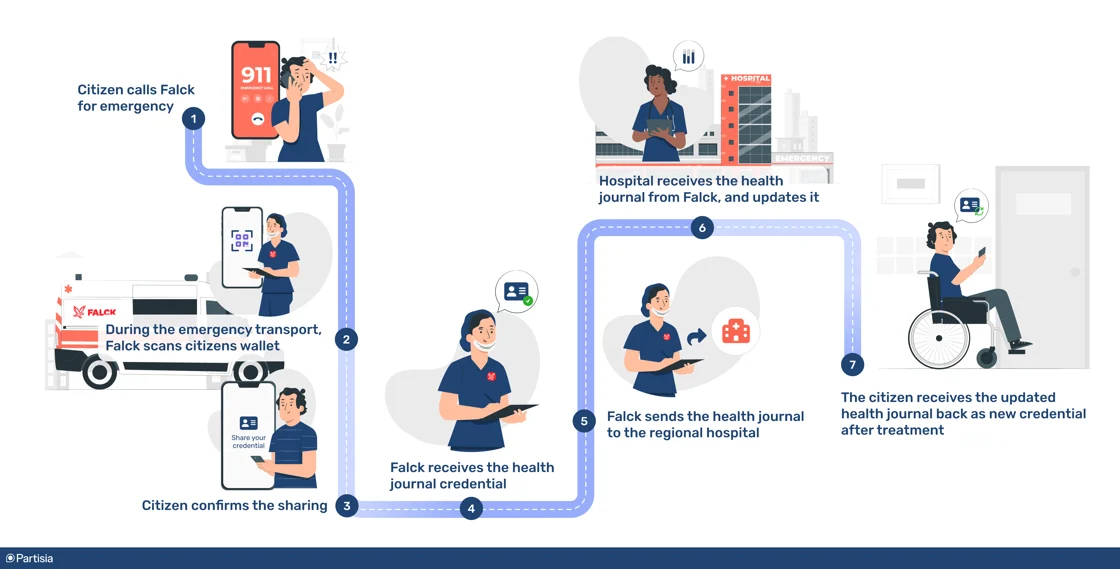
This solution illustrates how European innovation can complement broader DPI strategies, demonstrating scalable, privacy-preserving approaches that could be adapted for wider digital public infrastructure initiatives in partner countries.
→ Read more about Partisia here.
For questions, comments, or suggestions regarding this article, please get in touch with Emilia.
Enjoyed this edition of Decoding? Subscribe here to receive future insights on digital public services directly in your inbox.

.png)