.png)
Jan 2026
This article was originally published in Decoding, our monthly briefing on the latest trends in government technology. Sign up here to receive future editions directly in your inbox.
.png)
Europe enters 2026 at a pivotal moment for digital and geopolitical sovereignty. At the World Economic Forum in Davos, Canadian PM Mark Carney described the current geopolitical landscape as a rupture in the global order. EU President Ursula von der Leyen highlighted the imperative for Europe to build a new form of independence.
The start of the year has reinforced the need for Europe to strengthen internal cohesion while deepening strategic engagement with global partners. Digital and economic resilience, supply chain security, and regulatory influence are increasingly interconnected, shaping Europe’s ability to influence global cooperation. After 25 years of negotiations, the EU–Mercosur trade agreement was signed on 17 January, and later that week, the EU–India Free Trade Agreement was concluded, creating a trade zone of two billion people and nearly a quarter of global GDP. Both deals demonstrate Europe’s strategy to diversify trade partnerships and reduce strategic dependencies.
2026 is also set to be a crucial year for Europe’s digital policy. Key milestones include the adoption of the Digital Networks Act, the revised Cybersecurity Act, the full application of the AI Act from August, and the planned rollout of the Digital Omnibus and Digital Fairness Act later in the year. The EU Parliament's adoption of a report on technological sovereignty and digital infrastructure signals a determination to reduce dependence on US technologies and to expand the EU’s own capabilities.
This edition of Decoding focuses on the EU’s concrete actions and planned steps for the road ahead.
In this edition, you’ll read about:

Recent weeks have illustrated how closely security, trade and economic policy intersect. US pressure on the Kingdom of Denmark over Greenland, followed by swift backing from Nordic and European partners and the prospect of retaliatory tariffs, underscored how geopolitical disputes increasingly carry economic consequences.
The renewed focus on Greenland is not an isolated episode. Across the High North, the strategic value of Arctic territory is rising as melting ice opens new shipping routes, energy prospects and critical infrastructure corridors. Norway’s Svalbard archipelago, governed by a century-old treaty yet located along sensitive maritime and communications routes, illustrates how quickly long-settled arrangements can become exposed to geopolitical pressure. For Nordic countries, Arctic security is central to economic and defence policy. For Europe more broadly, this reinforces a clear imperative: resilience depends on stronger regional coordination and more diversified global partnerships. Agreements such as the EU–Mercosur and the EU–India trade deals should be seen in this light, not only as commercial instruments, but as part of a wider strategy to broaden Europe’s network of dependable partners in an increasingly contested global environment.
These shifts are not abstract geopolitical developments. They increasingly shape the practical choices governments make about digital infrastructure, procurement, and technology partnerships. Subsea cables, cloud providers, data centres, and AI systems are now part of the same resilience equation as trade routes and energy supply. Digital policy is no longer only about service delivery and efficiency; it is also about economic and security policy. Governments must consider how procurement, technology partnerships, and infrastructure choices affect continuity and independence under pressure.
This is where GovTech becomes strategic. From secure networks and sovereign cloud to interoperable digital identity and responsible AI, the tools of public sector digital transformation are also the tools of resilience.
On 1 January 2026, Denmark and the Faroe Islands formally assumed the presidency of the Nordic Council of Ministers, signalling a renewed focus on deepening regional cooperation at a pivotal moment for European security and competitiveness. Under the banner “The Nordic Region: Strong Ties in Changing Times”, the presidency emphasises societal security, energy and supply chain resilience, cross-border crime, and the protection of children and young people in the digital age.
A central priority is updating the Helsinki Treaty, the Nordic “constitution”, to reflect today’s eight-country cooperation framework and to ensure Greenland, the Faroe Islands, and, potentially, Åland have equal participation in Nordic decision-making. This step is both symbolic and strategic: integrating these territories strengthens regional cohesion while expanding the collective capacity to respond to evolving geopolitical and technological challenges.
For Denmark and the wider Nordic region, the presidency also underscores the link between governance, innovation, and competitiveness. By fostering cross-border collaboration in areas such as digital infrastructure, green technology, and societal resilience, the Nordic countries are actively building a regional model that combines trust, innovation, and robust public-sector capabilities. In a world of rising uncertainty, this approach positions the Nordics not only as a cohesive regional bloc but also as a testbed for GovTech solutions and collaborative frameworks that can inform Europe’s broader resilience strategies.
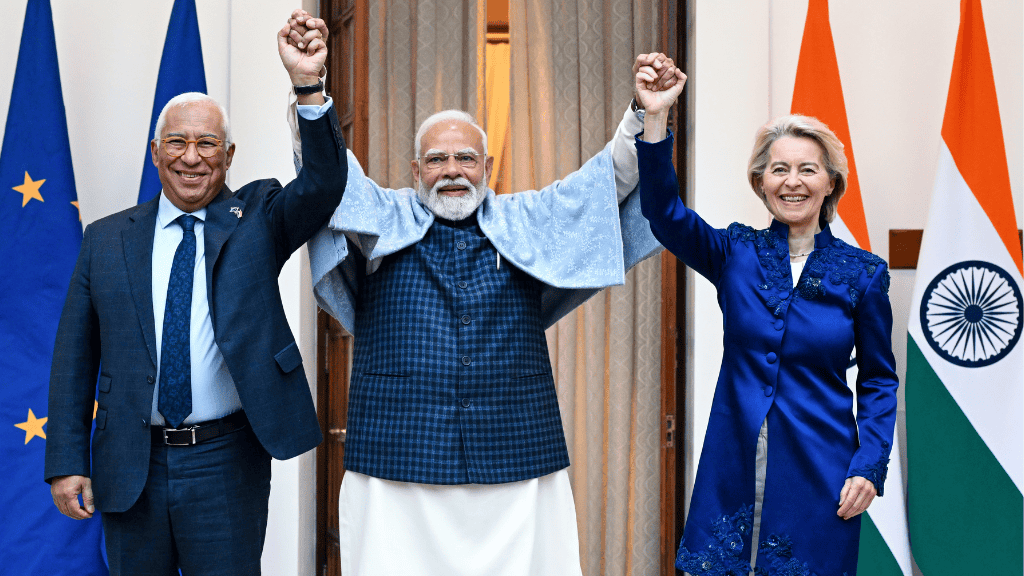
Beyond regional coordination, Europe is broadening its external partnerships in response to a less predictable global trading environment. Analysts describe this shift as an era of “weaponised interdependence,” where economic ties can be leveraged for political influence, prompting governments to reassess long-standing dependencies and seek broader, more balanced partnerships.
Recent trade agreements carry both symbolic and practical weight in this context. The EU-Mercosur partnership agreement and the EU-India Free Trade Agreement are about more than bilateral commerce. They send a strong geopolitical signal that these regions have a shared commitment to multilateralism and the rules-based international order. The EU and India also signed a Security and Defence Partnership, reflecting an expansion of the EU-India strategic relationship into non-traditional domains.
In this landscape, structured cooperation between the EU and the Comprehensive and Progressive Agreement for Trans-Pacific Partnership (CPTPP) offers a pragmatic route to diversification. As proposed by the European Commission, closer alignment between the two groupings could demonstrate that open trade among a broad set of partners remains viable on a rules-based foundation. A Joint Ministerial Statement and ongoing dialogue set out practical priorities, including trade diversification, digital trade, trade and investment facilitation, supply chain resilience, and support for WTO reform.
Together, the EU and CPTPP account for more than 30 per cent of global trade in goods. For Europe, deeper engagement therefore serves both economic and strategic aims: diversifying partners, lowering risk, and reinforcing a rules-based trading environment at a time when predictability can no longer be assumed.
On 22 January 2026, the European Parliament adopted a report on technological sovereignty and digital infrastructure with broad cross-party support from the EPP, Social Democrats, Liberals, and Greens. The report calls on the European Commission to pursue reforms such as a proposed Cloud and AI Development Act, and reaffirms the EU’s right to enforce its laws, including the Digital Services Act. In strategic sectors, member states are encouraged to favour European technology providers, with a focus on building a resilient and autonomous digital ecosystem. The Greens highlighted that EU-based solutions should be the default, with exceptions explicitly justified, and emphasised the use of cloud infrastructure under full EU jurisdiction.
A key element is the shift towards open-source and interoperable digital public infrastructure. The principle “Public Money, Public Code” is proposed as a foundation: software developed with public funds should be freely available under open licenses. Public-private investments, including proposals such as a €10 billion European Sovereign Tech Fund, are suggested to support infrastructure that the market alone may not provide.
Dependence on non-European providers exposes Europe to strategic risks, particularly as digital infrastructure is increasingly treated as a national security asset abroad. The Parliament’s report frames the "European Tech First" approach as a measure of self-determination and operational independence, prioritising open, controllable, and locally governed solutions over external dependencies.
In practice, this is likely to influence procurement rules, funding criteria, and the default selection of EU-based providers across public administrations. For those looking to explore European alternatives, this website provides an overview of European digital services and products.

🇬🇧 UK launches largest-ever facial recognition rollout as part of policing reforms: The UK Home Office is expanding live facial recognition (LFR) capabilities with 40 new LFR vans and investing £115 million (€133M) over three years in a National Centre for AI in Policing. The reforms aim to modernise police operations, improve crime detection, and streamline data governance by establishing a new National Police Service to oversee standards and the use of technology. Predictive analytics, digital forensics, and AI-driven crime-fighting tools will be deployed nationwide under a new regulatory framework.
🇩🇪 Germany launches citizen hackathon to modernise public administration: Germany’s Federal Agency for Disruptive Innovation (SPRIND) has announced a citizen hackathon to tackle bureaucratic inefficiencies through digital solutions. Citizens submit and vote on challenges, with the top projects developed by SPRIND’s Civic Tech Teams. Fifteen initiatives will receive funding and three months of support, with five teams implementing open‑source software. Inspired by Taiwan’s Presidential Hackathons, the initiative aims to modernise public services while strengthening participation and national cohesion.
🇸🇪 Sweden increases investment in European digital projects: Sweden is expanding its participation in the EU DIGITAL program by SEK 600 million (€54M) over six years to support Swedish actors in AI, cybersecurity, and digitalisation projects. The funding will co-finance proposals from Swedish companies, public authorities, and research institutions, with priority given to projects led by Swedish participants. The initiative aims to strengthen Sweden’s contribution to Europe’s digital development.
🇮🇪 Ireland to require government app for age verification on social media: Ireland will mandate the use of a government-developed digital wallet app for age assurance on social media and other age-restricted online services. The app, based on the existing MyGovID system and aligned with the EUDI Wallet, will verify users’ age before granting access. Communications Minister Patrick O’Donovan said the measure prioritises child safety, describing online harms as a “severe public health issue.” Noncompliance by platforms will incur significant fines. The rollout coincides with Ireland’s EU presidency in July 2026 and reflects the country’s broader focus on online child protection.
🇫🇷 France to phase out US video tools in government, shift to national platform: France will require public officials to stop using US-based videoconferencing services, including Google Meet, Zoom and Microsoft Teams, and instead adopt the state-developed platform Visio. The move forms part of a broader effort to place government communications on domestically controlled infrastructure and reduce reliance on foreign providers. Visio, hosted by French company Outscale, is already used by 40,000 staff, with a target of 250,000 users. Authorities plan to monitor compliance and may block alternative video tools on state networks as the transition progresses.
%20(1)%20Medium.jpeg)
Denmark’s digital strategy is increasingly reflected in the day-to-day design of public services. A new open-source school platform, OS2 Skole, shows how local GovTech choices can reduce reliance on large US vendors while strengthening control over data, costs, and capabilities.
Developed by the public digitalisation network OS2, the platform operates independently of proprietary ecosystems and prioritises pedagogy, digital literacy, transparency and privacy-by-default protections for children’s data. The aim is not simply to replace tools, but to give schools and municipalities greater freedom to shape solutions that align with public values and local needs.
The initiative has gained early momentum. Twenty-three of Denmark’s 83 municipalities are backing the project. Today, most schools depend on proprietary tools from Google or Microsoft. According to the project group, Denmark spends approximately DKK 66.5 million annually on licences. OS2 Skole is projected to lower costs through shared development and local maintenance, with funds redirected from licences to in-house skills and regional suppliers.
The case also reflects a broader shift in the risk landscape. Recent geopolitical tensions have underscored the strategic implications of reliance on foreign technology providers, alongside financial and operational ones. In this context, dependence on US-based platforms is increasingly viewed not only as a procurement choice but as a question of resilience and autonomy. For many municipalities, this is placing renewed emphasis on open source and European alternatives that offer greater transparency, control and continuity.
At the same time, open source requires stronger public capability. A recent report by the Danish Digitalisation Agency notes that authorities must develop new technical and organisational skills and take greater responsibility for operating the solutions they choose. Advocates within the OS2 community argue that this ownership is precisely the point: open technologies are free, transparent and aligned with democratic values, and reduce structural dependence on commercial vendors whose incentives may not align with public interests.
OS2 Skole illustrates GovTech as strategy in practice: procurement, architecture and licensing decisions directly shape resilience, trust and long-term control. As Europe debates its digital independence at EU level, Denmark’s municipal approach shows how those ambitions can be implemented through everyday public infrastructure.
For questions, comments, or suggestions regarding this article, please get in touch with Emilia.
Enjoyed this edition of Decoding? Subscribe here to receive future insights on digital public services directly in your inbox.

.png)